What is a CIP and SIP system and how does it ensure equipment sterility?

In biopharmaceutical production under GMP conditions, cleaning and sterilizing process equipment is essential to guarantee final product quality. CIP and SIP systems are standardized solutions that ensure tanks, piping, heat exchangers, sensors, and contact elements remain contamination-free between batches. Their use is critical in environments where reproducibility, traceability, and regulatory compliance are priorities, especially in facilities handling sterile, sensitive, or high-value products.

CIP system (Cleaning In Place)

A CIP system enables automated cleaning of the interior of process equipment without disassembly, significantly reducing downtime and the risk of cross-contamination. A typical sequence includes pre-rinsing with water, application of detergent solutions (usually alkaline or acidic) at controlled temperatures, intermediate rinses, and a final rinse with purified water or WFI (Water for Injection), depending on the required cleaning level.

Key components of a CIP system include:

  • Tanks for preparation and storage of cleaning solutions, with agitation and thermal control
  • Distribution circuits with dosing pumps, control valves, sanitary manifolds, and a design that avoids dead legs
  • Sensors for continuous monitoring of temperature, pressure, flow rate, conductivity, pH, and contact time
  • Control software with predefined recipes and electronic validation

The equipment design is crucial. It must ensure complete drainage, smooth surfaces, and sanitary connections. Additionally, the CIP cycle must be validated under “worst-case” conditions to ensure its effectiveness in extreme scenarios.
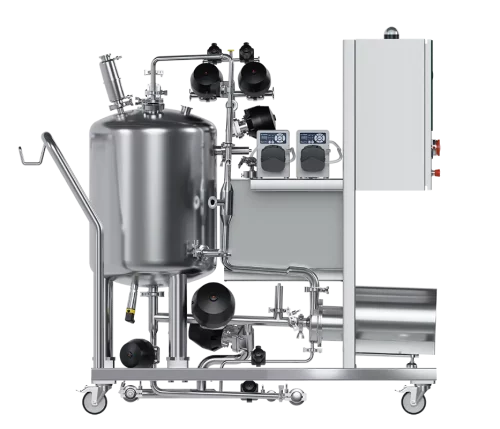
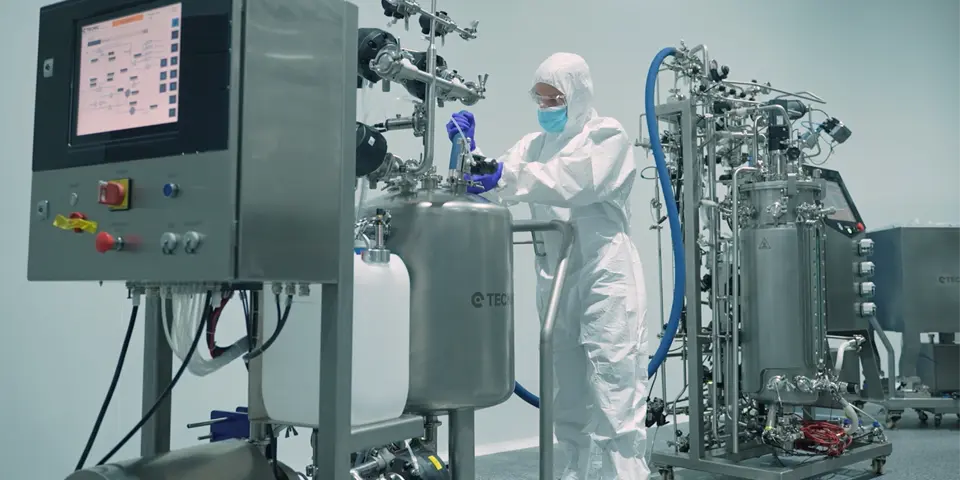
Stainless steel CIP (Clean-in-Place) system used in bioprocessing for automated internal cleaning of equipment without disassembly, featuring tanks, valves, and control panel.

SIP system (Sterilization In Place)

The SIP system sterilizes process equipment by injecting clean steam, typically at temperatures of 121°C or higher for a defined period. This process eliminates all viable microbial life, including resistant spores, ensuring asepsis before the next production cycle.

Critical parameters of an SIP cycle include:

  • Controlled temperature and pressure, with precise recording of each phase (preheating, sterilization, cooling)
  • Validation of uniform steam distribution throughout the system using temperature probes and steam penetration tests
  • Traceable cycle documentation with electronic signatures
  • Integration with SCADA or MES systems for centralized monitoring, alarms, trends, and automatic reporting

SIP system design must consider steam-compatible materials, proper thermal insulation, condensate control, and continuous drainage during the sterilization phase.

CIP and SIP integration in GMP environments

Combining CIP and SIP systems in an automated workflow offers clear advantages in efficiency, reproducibility, and regulatory compliance. These systems can operate sequentially or in parallel, depending on plant configuration, minimizing changeover times and ensuring rapid equipment availability. In multiproduct processes, proper CIP and SIP integration is critical to avoid cross-contamination and ensure inter-batch validation.

An effective integration should include:

  • Full cycle validation with DQ/IQ/OQ/PQ protocols
  • Execution traceability through electronic records, audit trails, and electronic signature systems
  • Alarms and interlocks for critical deviations such as pressure drops or out-of-spec temperatures
  • Connectivity with other plant systems (ERM, Historian, BMS), enabling integrated management of quality, maintenance, and production
  • Cycle efficiency evaluation through OEE and performance parameters
Technical and regulatory advantages

  • Compliance with international regulations (FDA, EMA, PIC/S, WHO).
  • Significant reduction in human error thanks to full automation.
  • Standardization of cleaning and sterilization processes across production units.
  • Improved operational efficiency by reducing downtime between batches.
  • Better resource management (water, heat, energy) through optimized cycles.
  • Easier preparation for regulatory audits and generation of compliance reports.

Conclusion

The implementation of CIP and SIP systems is a fundamental pillar of quality assurance in biopharmaceutical environments. These systems not only ensure safe cleaning and sterilization of equipment but also optimize operation time, improve process consistency, and strengthen regulatory compliance. TECNIC contributes to this mission with tailored solutions that combine efficiency, technology, and reliability at every stage of the production process, helping our clients operate with maximum safety and competitiveness.

¿What is a CIP and SIP system and how does it ensure equipment sterility?

Frequently Asked Questions (FAQ)

1. What is a CIP system?

A CIP (Cleaning In Place) system automatically cleans process equipment internally, without disassembly, using controlled detergent and rinse cycles.

2. What is a SIP system?

SIP (Sterilization In Place) uses clean steam at high temperatures to sterilize equipment, eliminating all microbial life before the next batch.

3. Why are they important in GMP environments?

They prevent cross-contamination, ensure product safety, and support compliance with regulatory standards.

4. Which equipment can be cleaned or sterilized with CIP and SIP?

Tanks, piping, heat exchangers, sensors, and any product-contact surfaces.

5. Can CIP and SIP be integrated?

Yes, integration improves efficiency, reduces downtime, and ensures full traceability and validation.

Subscribe to our newsletter

Newsletter Form

Contact form

Your opinion is very important to us, and we encourage you to contact our sales team to discuss the purchase of our bioprocess equipment. We are here to answer your questions and help you find the best solution for your needs.

Quote
Related Content

Quote

Quote
Image to access to all TECNIC's features, you can see a person working with the ePilot Bioreactor.

Coming soon 

We are finalizing the details of our new equipment. Soon, we will announce all the updates. If you want to receive all the latest news about our products, subscribe to our newsletter or follow our social media channels. 

Newsletter Form

Sign Up

Stay informed about our product innovations, best practices, exciting events and much more! After signing up for our newsletter, you can unsubscribe at any time.

Newsletter Form

Cassette

We understand the importance of flexibility and efficiency in laboratory processes. That's why our equipment is designed to be compatible with Cassette filters, an advanced solution for a variety of filtration applications. Although we do not manufacture the filters directly, our systems are optimized to take full advantage of the benefits that Cassette filters offer.

Cassette filters are known for their high filtration capacity and efficiency in separation, making them ideal for ultrafiltration, microfiltration, and nanofiltration applications. By integrating these filters into our equipment, we facilitate faster and more effective processes, ensuring high-quality results.

Our equipment, being compatible with Cassette filters, offers greater versatility and adaptability. This means you can choose the filter that best suits your specific needs, ensuring that each experiment or production process is carried out with maximum efficiency and precision.

Moreover, our equipment stands out for its 100% automation capabilities. Utilizing advanced proportional valves, we ensure precise control over differential pressure, transmembrane pressure, and flow rate. This automation not only enhances the efficiency and accuracy of the filtration process but also significantly reduces manual intervention, making our systems highly reliable and user-friendly.

Hollow Fiber

We recognize the crucial role of flexibility and efficiency in laboratory processes. That's why our equipment is meticulously designed to be compatible with Hollow Fiber filters, providing an advanced solution for a broad spectrum of filtration applications. While we don't directly manufacture these filters, our systems are finely tuned to harness the full potential of Hollow Fiber filters.

Hollow Fiber filters are renowned for their exceptional performance in terms of filtration efficiency and capacity. They are particularly effective for applications requiring gentle handling of samples, such as in cell culture and sensitive biomolecular processes. By integrating these filters with our equipment, we enable more efficient, faster, and higher-quality filtration processes.

What sets our equipment apart is its 100% automation capability. Through the use of sophisticated proportional valves, our systems achieve meticulous control over differential pressure, transmembrane pressure, and flow rate. This level of automation not only boosts the efficiency and precision of the filtration process but also significantly diminishes the need for manual oversight, rendering our systems exceptionally reliable and user-friendly.

Contact General

Cellular configuration

The cellular configuration of the eLab Advanced is equipped with a pitched-blade impeller designed to support efficient mixing for cell culture processes in both laboratory development and early scale-up. The blade geometry promotes mainly axial flow, helping to distribute gases, nutrients and pH control agents uniformly throughout the vessel while keeping shear stress at a moderate level. This makes it suitable for mammalian, insect and other shear-sensitive cell lines when operated with appropriate agitation and aeration settings. In combination with the vessel aspect ratio and baffle design, the pitched blade supports stable foaming behavior and reproducible oxygen transfer, which is essential when comparing batches or transferring processes between working volumes.

Operators can fine-tune agitation speed to balance oxygen demand and mixing time without excessively increasing mechanical stress on the culture. 

Cellular configuration

The cellular configuration of the eLab Advanced is equipped with a pitched-blade impeller designed to support efficient mixing for cell culture processes in both laboratory development and early scale-up. The blade geometry promotes mainly axial flow, helping to distribute gases, nutrients and pH control agents uniformly throughout the vessel while keeping shear stress at a moderate level. This makes it suitable for mammalian, insect and other shear-sensitive cell lines when operated with appropriate agitation and aeration settings. In combination with the vessel aspect ratio and baffle design, the pitched blade supports stable foaming behavior and reproducible oxygen transfer, which is essential when comparing batches or transferring processes between working volumes.

Operators can fine-tune agitation speed to balance oxygen demand and mixing time without excessively increasing mechanical stress on the culture. 

Cellular configuration

The cellular configuration of the eLab Advanced is equipped with a pitched-blade impeller designed to support efficient mixing for cell culture processes in both laboratory development and early scale-up. The blade geometry promotes mainly axial flow, helping to distribute gases, nutrients and pH control agents uniformly throughout the vessel while keeping shear stress at a moderate level. This makes it suitable for mammalian, insect and other shear-sensitive cell lines when operated with appropriate agitation and aeration settings. In combination with the vessel aspect ratio and baffle design, the pitched blade supports stable foaming behavior and reproducible oxygen transfer, which is essential when comparing batches or transferring processes between working volumes.

Operators can fine-tune agitation speed to balance oxygen demand and mixing time without excessively increasing mechanical stress on the culture. 

Microbial configuration

The microbial configuration of the eLab Advanced is equipped with a Rushton turbine specifically designed for high-oxygen-demand processes such as bacterial and yeast fermentations. The radial-flow impeller generates strong mixing and intense gas dispersion, promoting high oxygen transfer rates and fast homogenization of nutrients, antifoam and pH control agents throughout the vessel. This makes it particularly suitable for robust microbial strains operating at elevated agitation speeds and aeration rates.

Operators can adjust agitation and gas flow to reach the required kLa while maintaining consistent mixing times, even at high cell densities. This configuration is an excellent option for users who need a powerful, reliable platform to develop and optimize microbial processes before transferring them to pilot or production scales.